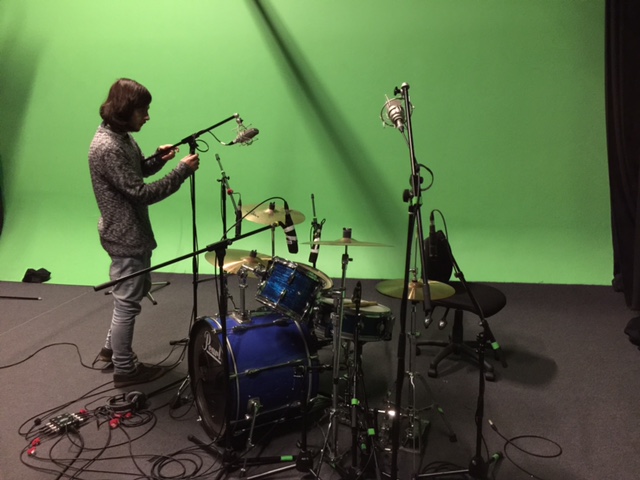
This week we continued work on some music cues for the upcoming web series. Our chosen scene involved the main character being antagonised until he retaliates violently. This is a moment of transition for the character as we see him finally break and react to his mistreatment, and we feel his catharsis along with the anarchy and absurdity of the situation. Our aim was to represent this build-up of tension and release with a percussive and heavy track inspired by bands like ‘Tool’ and ‘System Of A Down’. We set up a drum kit in the Audient / Green room studio and recorded 4 progressive rhythms in 5/4 time with the view to create a set of music cues that could be cut together for multiple uses. In future sessions we aim to add appropriate guitar and bass tracks to fill it out. In the studio we bunched most of the large curtains into the back corner behind the kit, leaving the walls reflecting away from the kit. We were quite happy with the sounds on the day and it suited the style we were going for.
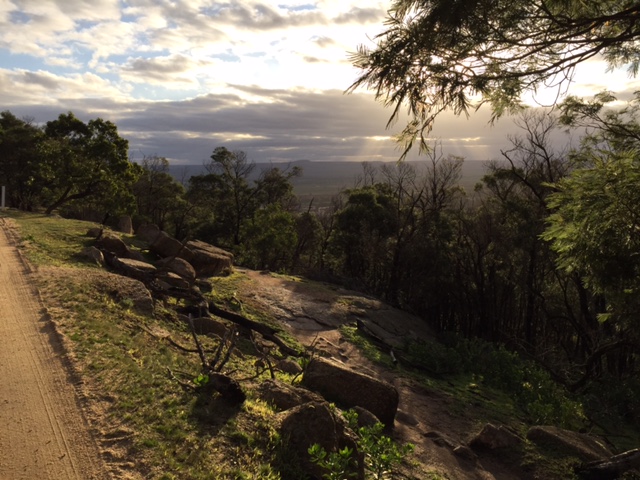
On the weekend I went on a mission to record some stereo atmos tracks, in particular a beachfront and bushland ambience. These both proved to be surprisingly difficult as there was much more man-made interruption (planes, cars, people talking) than I had expected or would probably have noticed without the mics. I think there’s some usable stuff in there, but I may need to go further afield to try gain. Below are some photos from Werribee South boat ramp and the You Yangs national park.
Also this week we are starting to look at mastering techniques. This should be very helpful as I’ve often mastered the majority of my productions – either as an audition track for a client, or as the final release itself. I have a couple of go-to processes that I like to use, but I’m very interested in finding out what the industry standard practices are and developing my approach a lot further. In class we discussed the present state of mastering with regard to modern listening environments and in the aftermath of the loudness wars in the early 2000s . From my own perspective, I think that we are in a good place and getting better. Digital audio workflow has been around long enough now for the novelty of an overly loud / bright mix to be wearing off. There is also a bit of a retro-soul revival happening in Pop, with hugely successful tracks like Daft Punk’s “Get Lucky”, and Mark Ronson’s “Uptown Funk” in the last couple of years which have a distinctly analog feel to match the style of the music. This is compatible with the current RnB dominance of mainstream music and I think it proves that a warm dynamic sound is popular. There is also the relative homogenisation of playback devices compared with previous decades – you can be certain that a large percentage of the audience will hear the mix on an iPhone speaker / Apple product at some point, and these can be referenced precisely. The same could be said for Beats headphones in certain genres. In some ways this can take out some of the guesswork around the mix translating into the real world. Add to this the level-matching features of Spotify and iTunes, and the wider dynamic range of digital radio, I suspect that the process of mastering may become simpler. For a while anyway.
Cheers!



 brendanmuller